

Flooded polder helps fight mosquito-borne diseases
One and a half hectares of polder, a large volume of water, and a group of curious researchers with diverse scientific backgrounds from various universities. These are the ingredients needed to answer the question: how do water storage areas affect nature, animals, and our health?
Due to climate change, we are facing longer periods of higher temperatures and drought, followed by heavy rainfall. Peak storage areas – land that can be temporarily flooded – are a solution to prevent flooding in cities. But can they become breeding grounds for disease carriers such as mosquitoes and migratory birds? And what does that mean for the spread of viruses?
To find out, researchers from different universities, research institutes, governments, and nature organizations temporarily flooded more than a hectare of the Eendragtspolder in Zevenhuizen this past August. For everyone involved, this was the moment they had been waiting on for three years, said Maarten Schrama from Leiden University just before the inundation – a fancy word for submerging land under water. “It is crucial to collaborate with all these parties and to examine the impacts ranging from water quality to the experience of local residents.”
Living laboratory
The Eendragtspolder was designed as a water buffer to protect Rotterdam during extreme rainfall. The area can hold four million cubic meters of water. For the field study, the researchers were able to utilize a section of it as a living laboratory. “We measure temperature, weather, bird behavior, the number of mosquitoes – everything is being documented,” explained researcher Reina Sikkema of Erasmus MC before she and Schrama switched on the water pump. “We know that climate change is causing more and more viruses to emerge, but we don’t know what effect such a water storage area has in relation to those viruses. Being able to study that here is really special.”
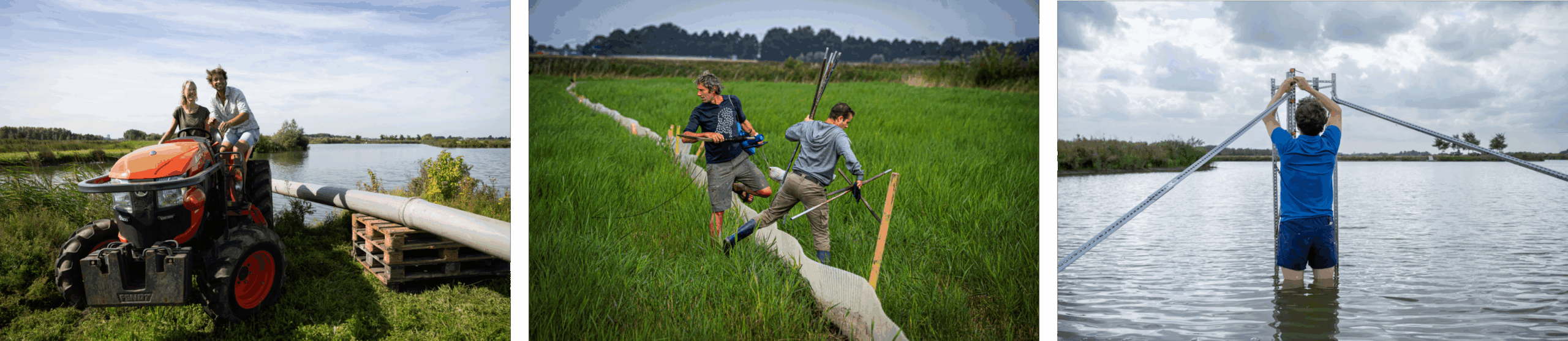
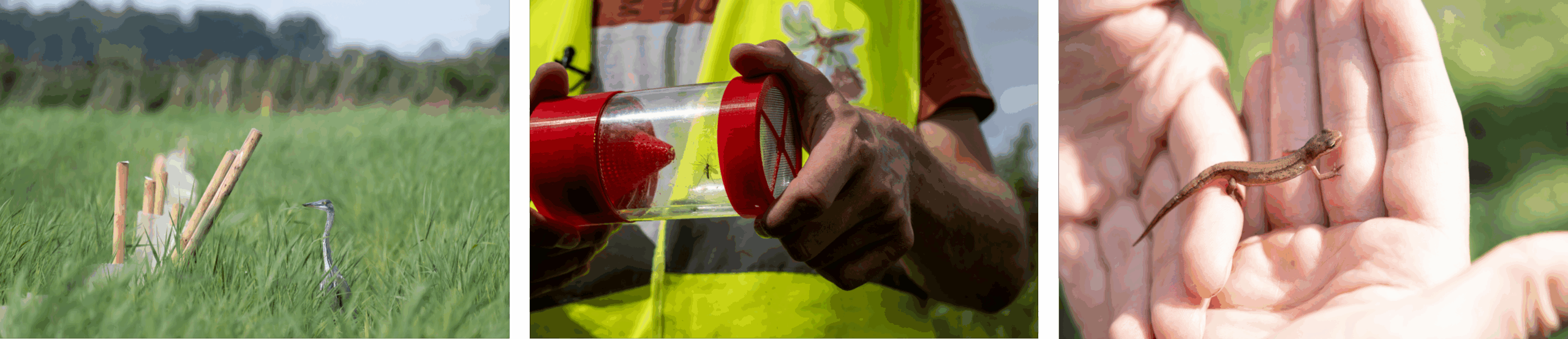
As soon as the water entered the polder, the environment changed. Hidden in the grass were far more animals and insects than met the eye at first. An unexpectedly high number of salamanders, moles, and mice quickly sought out a drier place, sometimes helped along by one of the researchers. A week and a half later, besides mosquitoes and other insects, many birds had also come to the wet polder. “We notice it’s a place that attracts a lot of activity. We’re seeing crows, pigeons, waders, and many more species,” said Schrama. “We even spotted a purple swamphen.”
The arrival of birds is good news for the study: mosquitoes cannot fly far, but birds can. Which species carry which viruses, and how far they spread them, remains to be investigated. The birds drawn to the wet polder can help answer those questions. Smaller animals such as salamanders are also being studied. They do not carry diseases but do eat mosquitoes and can thus play a role in reducing the spread of viruses.
After the experiment
The research in the flooded part of the polder lasted more than two weeks. During that time, the researchers stayed in a nearby holiday cottage. From early in the morning until late in the evening they were busy with fieldwork, in waders or barefoot. The amount of data they collected is enormous. The analysis will take months, but the experiment is already considered a success.
“The insights we gain from this research allow us to take preventive measures and to design water storage areas effectively. For example, by choosing vegetation that deters certain species, or by making areas less attractive to mosquitoes. This way, we can be better prepared for a future in which climate change – and our response to it – continues to reshape our living environment,” concluded Sikkema.
Project partners
This experiment is one of the Frontrunner Projects of the Pandemic and Disaster Preparedness Center (PDPC). The PDPC is a collaboration between Erasmus University Rotterdam, Erasmus MC, and TU Delft, and is one of five Convergence programs aimed at preparing society for future disasters and pandemics.
Other partners in this project include: KNMI, Naturalis, GGD Hollands Midden, GGD Rotterdam-Rijnmond, Staatsbosbeheer, Natuur- en Vogelwacht Rotta, Recreatieschap Rottemeren, Leiden University, Sovon, Netherlands Institute of Ecology (NIOO-KNAW), Wageningen University & Research (WUR), Schieland and Krimpenerwaard Water Board (HHSK), Blanes Centre for Advanced Studies (CEAB), Municipality of Rotterdam, Dutch Youth Association for Nature Study (NJN), and Municipality of Zuidplas.
